
Aaron Sander M.Sc.

Aaron Sander M.Sc.
PhD Student

Arcisstrasse 21, 4th floor, room 4999
aaron.sander@tum.de

GitHub LinkedIn Google Scholar

Research

Interests

  • Quantum simulation techniques (Tensor networks, neural quantum states)
  • Open quantum systems, including quantum hardware emulation and noise characterization
  • Noisy quantum algorithms
  • Application of tensor network techniques to problems outside of quantum physics

Publications

Publications at the Chair for Design Automation

Journals

  1. A. Sander, L. Burgholzer, and R. Wille. Equivalence checking of quantum circuits via intermediary matrix product operator. Physical Review Research, 2025. arXiv:2408.11894, DOI, PDF.

Conferences, Workshops, etc. with Proceedings

  1. Aaron Sander, Rosaria Cercola, Andrea Capogrosso, Stefan Filipp, Bernhard Jobst, Christian B. Mendl, Frank Pollmann, Christopher Trummer, Isabell Welpe, Max Werninghaus, Robert Wille, and Christian Wimmer. Quantum Entrepreneurship Lab: Training a Future Workforce for the Quantum Industry. In IEEE International Conference on Quantum Computing and Engineering (QCE). 2025.
  1. R. Wille, L. Berent, T. Forster, J. Kunasaikaran, K. Mato, T. Peham, N. Quetschlich, D. Rovara, A. Sander, L. Schmid, D. Schoenberger, Y. Stade, and L. Burgholzer. The MQT Handbook: A Summary of Design Automation Tools and Software for Quantum Computing. In IEEE International Conference on Quantum Software (QSW). 2024. Invited Paper. arXiv:2405.17543, DOI, PDF.
  1. A. Sander, L. Burgholzer, and Robert Wille. Stripping Quantum Decision Diagrams of Their Identity. In IEEE International Conference on Quantum Software (QSW). 2024. Received Best Student Paper Award. arXiv:2406.11959, PDF.
  1. A. Sander, L. Burgholzer, and R. Wille. Towards Hamiltonian Simulation with Decision Diagrams. In IEEE International Conference on Quantum Computing and Engineering (QCE). 2023. arXiv:2305.02337, PDF.

Preprints

  1. A. Sander, M. Fröhlich, M. Eigel, J. Eisert, P. Gelß, M. Hintermüller, R. M. Milbradt, R. Wille, and C. B. Mendl. Large-scale stochastic simulation of open quantum systems. 2025. arXiv:2501.17913, PDF.

Other Publications

  • K. Pushkin, et al. Study of radon reduction in gases for rare event search experiments. In Nuclear Instruments and Methods in Physics Research Section A: Accelerators, Spectrometers, Detectors and Associated Equipment. 2018. DOI.

  • J. Haefner, et al. Reflectance dependence of polytetrafluoroethylene on thickness for xenon scintillation light. In Nuclear Instruments and Methods in Physics Research Section A. 2017. DOI.

Curriculum Vitae

Personal Data

Name:Aaron Sander
Nationality:American

Education

01/2023-PresentDoctoral Candidate, Technical University of Munich, Germany
10/2020–10/2022Master of Science, Quantum Science & Technology, LMU Munich, Technical University of Munich, Germany
10/2017–10/2020Bachelor of Science, Physics, LMU Munich, Germany
09/2015–05/2016Bachelor of Science, Engineering Physics, University of Michigan, Ann Arbor, Michigan, USA
08/2011–05/2015High School Diploma, Farragut High School, Knoxville, Tennessee, USA

Experience

07/2022–12/2022Quantum Research Scientist, Quantinuum, Munich, Germany
06/2020–06/2022Analog Engineer (Silicon Design), Intel, Munich, Germany
11/2018–05/2020Lab Manager (Emerging Technologies), Intel, Munich, Germany
06/2016–10/2018Hardware Engineer, Bourns Sensors, Munich, Germany
09/2015–05/2016Research Assistant (LUX-Zeplin Project), Ann Arbor, Michigan, USA

Back to top

Contact

Technical University of Munich
School of Computation, Information and Technology
Chair for Design Automation
Prof. Dr. Robert Wille
Arcisstrasse 21
80333 Munich | Germany
robert.wille@tum.de
Tel: +49 89 289 23551

How To Find Us


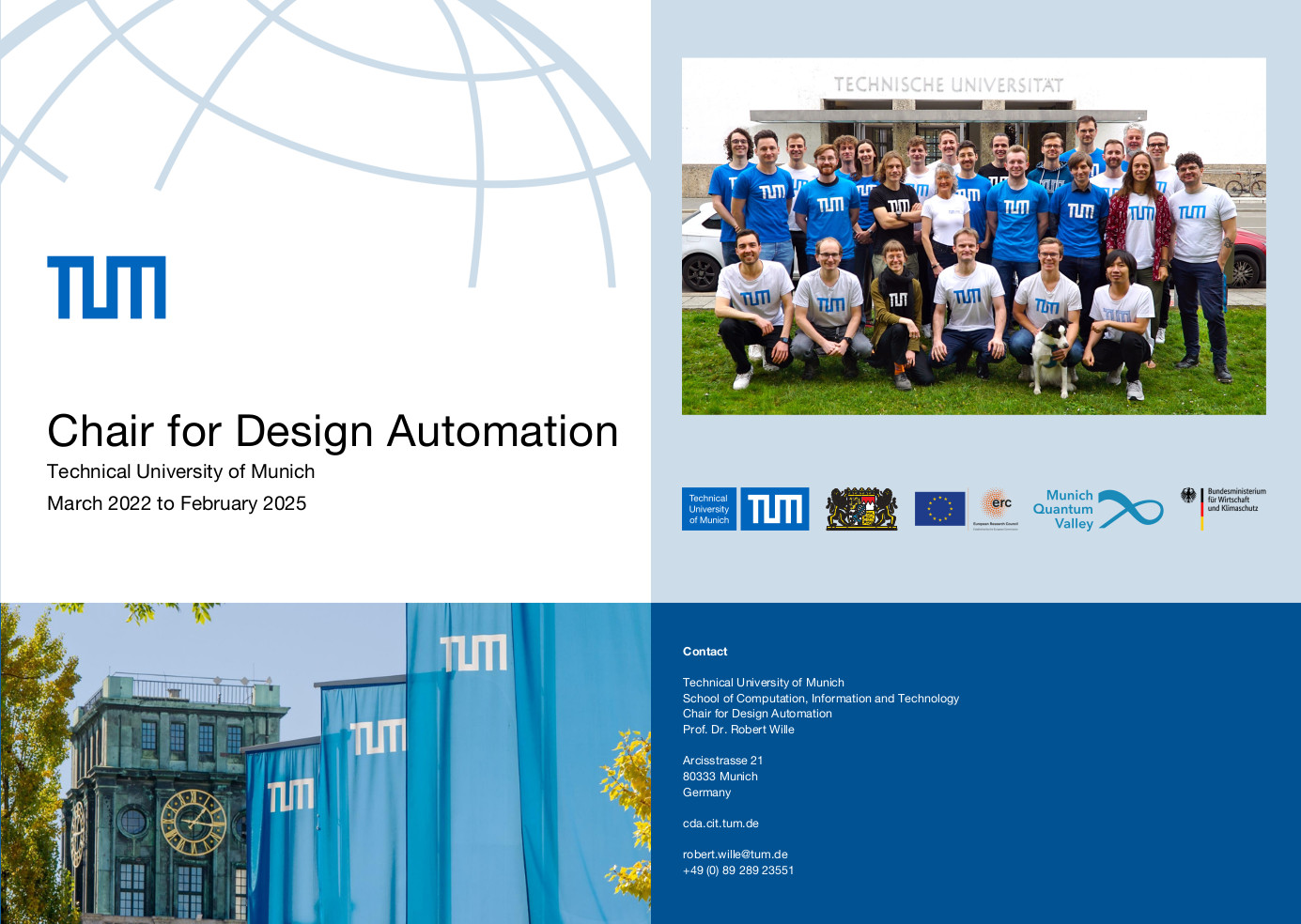
CDA Report pdf
Read our three year annual report!


MQSF Logo
Find the announcement here!


The Chair for Design Automation is supported by the Bavarian State Ministry for Science and Arts through the Distinguished Professorship Program.

Der Lehrstuhl für Design Automation wird durch das Bayerische Staatsministerium für Wissenschaft und Kunst im Rahmen des Spitzenprofessurenprogramms gefördert.

Bavarian Coat of Arms