Supporting Users in Realizing Quantum Computing Applications
Realizing quantum computing applications requires a number of different steps, ranging from the selection of a suitable quantum algorithm to its execution. To date, these tasks still substantially rely on manual labour even for experienced quantum users. In our work, various methods, tools, and repositories are proposed to support quantum users in conducting those tedious and error-prone steps, shielding them from the complex inner workings of quantum computing and providing ways to reason over them even when state-of-the-art hardware still has not yet reached the required level. The resulting software is available as part of the Munich Quantum Toolkit (MQT).

In our group, we develop methods and envision a design flow which support end-users in realizing their quantum computing applications. They aim to shield the end-user as much as possible from the intricacies of quantum computing through automation and guidance. In the following, those methods and software tools are described and illustrated.
MQT ProblemSolver [1]
We envision and propose a framework called MQT ProblemSolver which aims at simplifying the realization of quantum computing solutions—particularly for end-users from the various application domains:
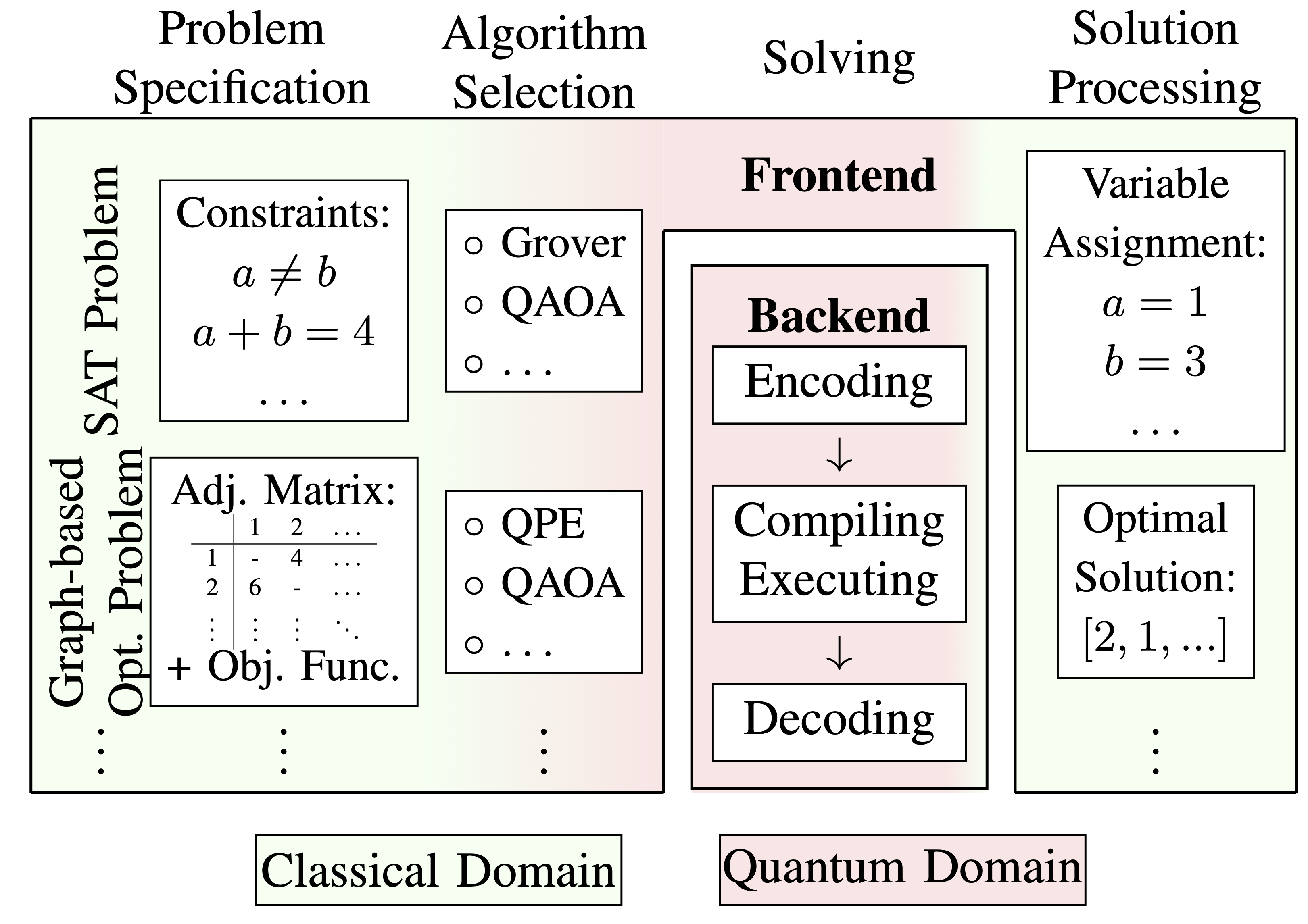
To this end, we exploit the fact that the current workflow summarized above actually offers tangible opportunities to shield the user as much as possible from the intricacies of quantum computing. This is accomplished by keeping the interfaces for both, the problem input and the solution output formats, as similar as possible to classical solvers and by providing guidance for the quantum algorithm selection procedure. Using this as a basis, the remaining steps (encoding, compiling, executing, and decoding) are then covered in a fully automated fashion.
To demonstrate the feasibility and usability of such a framework, a proof-of-concept implementation—which is publicly available on GitHub —has been realized for two different problem classes: Satisfiability Problems (SAT problems) and Graph-based Optimization Problems. For both, corresponding case studies confirmed the benefits from a end-user’s perspective. By this, the proposed framework provides the foundation for a low-threshold approach of realizing quantum computing solutions with no or only moderate background in this technology.
For more details, please refer to the following paper:
- N. Quetschlich, L. Burgholzer, and R. Wille. Towards an Automated Framework for Realizing Quantum Computing Solutions. In International Symposium on Multiple-Valued Logic (ISMVL). 2023. PDF
QUBO Tools [2]
The Quantum Approximate Optimization Algorithm (QAOA) is a popularly employed variational quantum algorithm that can be used to approximate the solutions of optimization problems. This algorithm, however, requires the inputs to be provided in the Quadratic Unconstrained Binary Optimization (QUBO) format. This means that arbitrary optimization problems first require rigorous rewriting to solve them using QAOA, a process that is not only very time-consuming and error-prone, but also requires substantial expertise in the field.
Through its QUBO Tools, the MQT provides a framework that automates the process of creating such QUBO formulations. It contains a Python API that allows the construction of QUBO cost functions as a collection of constraints. Furthermore, a graphical user interface can also be used to create QUBO formulations without the need for any code at all.
The generated QUBO cost functions can be constructed with the aim to minimize the required number of qubits, but the framework also provides a method for the hardware-efficient construction of QUBO formulations that takes advantage of the interaction structure to create QAOA instances that can be more efficiently mapped to superconducting device architectures.
For more details, please refer to the following papers:
- D. Rovara, N. Quetschlich, and R. Wille. A Framework to Formulate Pathfinding Problems for Quantum Computing. 2024. arXiv:2404.10820 , PDF
- D. Rovara, L. Burgholzer, and R. Wille. Quantum Hardware-Efficient Selection of Auxiliary Variables for QUBO Formulations. In Design, Automation and Test in Europe (DATE). 2026. PDF
Resource Estimation [3, 4]
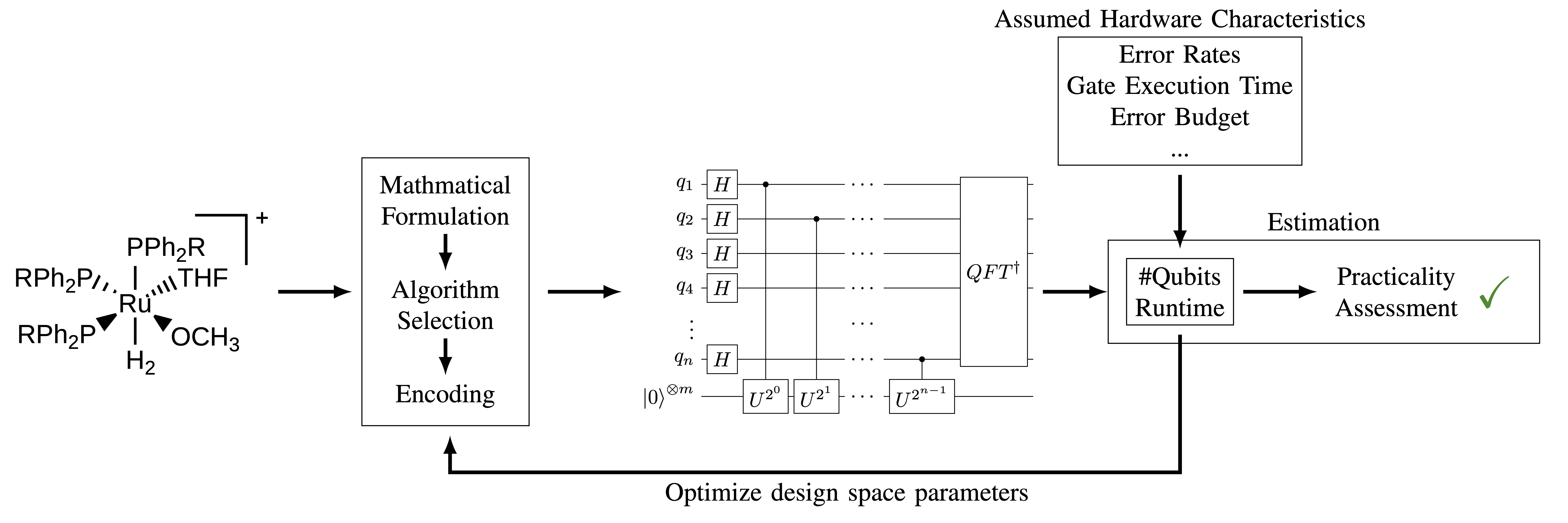
Unfortunately, quantum simulators suffer from their exponential complexity and, at the same time, the currently available quantum computing hardware is still rather limited (even if roadmaps make intriguing promises). Hence, in order to evaluate quantum computing applications, end-users are still frequently restricted to toy-size problem instances (which additionally often do not take error correction into account). This substantially hinders the development and assessment of real-world quantum computing applications. To this end, we demonstrate how to utilize Resource Estimation to improve this situation. We show how the current workflow (relying on simulation and/or execution) can be complemented with an estimation step, allowing that end-users
- actually can consider real-world problem instances already today (also considering error correction schemes and correspondingly required hardware resources),
- can start exploring possible optimizations of those instances across the entire design space, and
- can incorporate hypotheses of hardware development trends to derive more informed and, thus, better design space parameters. Overall, this enables end-users already today to check out the promises of possible future quantum computing applications, even if the corresponding hardware to execute them is not available yet.
For more details, please refer to the following paper:
- N. Quetschlich, M. Soeken, P. Murali, and R. Wille. Utilizing Resource Estimation for the Development of Quantum Computing Applications. 2024. arXiv
MQT Debugger [5, 6, 7]
While many of the above tools can provide pre-built quantum circuits without requiring any expertise from the users, complex use cases often demand custom circuits developed from scratch. Given the inherent complexity of quantum computing, bugs in these custom circuits are inevitable. In fact, commit histories in public repositories reveal that bug fixes often arrive weeks, months, or even years after a circuit is published.
MQT Debugger addresses this challenge by providing an efficient framework for detecting bugs in quantum circuits. It evaluates runtime assertions on both simulated devices and real quantum hardware. Upon an assertion failure, the tool utilizes semi-automated debugging methods to pinpoint potential root causes. This is achieved by providing a comprehensive debugging workflow:
- Quantum Assertions [5, 6, 7]: A set of different types of assertions can be introduced in OpenQASM code. They can be evaluated during circuit simulation.
- Automated Diagnostics [5]: On failing assertion, potential error causes are pointed out through static and dynamic code analysis.
- Assertion Refinement [6]: As the quality of the employed assertions strongly determines their usefulness, automated methods are provided to improve the quality of existing assertions automatically.
- Runtime Evaluation on Real Quantum Computers [7]: As real devices only provide limited access to the state during execution, the MQT Debugger provides functionalities to automatically translate assertions in measurements that can be evaluated on quantum computers and to evaluate the assertions’ correctness based on execution results.
For more details, please refer to the following papers:
- D. Rovara, L. Burgholzer, and R. Wille. Automatically Refining Assertions for Efficient Debugging of Quantum Programs. In IEEE International Conference on Quantum Computing and Engineering (QCE). 2025. PDF
- D. Rovara, L. Burgholzer, and R. Wille. A Framework for Debugging Quantum Programs. In IEEE International Conference on Quantum Software (QSW). 2025. PDF
- D. Rovara, L. Burgholzer, and R. Wille. A Framework for the Efficient Evaluation of Runtime Assertions on Quantum Computers. 2025. arXiv:2505.03885 , PDF
MQT Bench [8]
Tools like the ones proposed above but also, e.g., for the simulation, compilation, verification, etc. of quantum circuits are key in order to support end-users in the realization of their quantum computing application. And, thankfully, a huge variety of tools has been proposed in the past—with many more to come. However, whenever such a quantum software tool is proposed, it is important to empirically evaluate its performance and to compare it to the state of the art. For that purpose, proper benchmarks are needed. To provide those, MQT Bench is proposed — a cross-level benchmark library designed to accelerate innovation across quantum software, hardware, and AI. It offers a rich set of pre-generated circuits and supports custom benchmark generation across four abstraction levels, scaling from 2 up to 200 qubits. With consistent and reproducible benchmarking, MQT Bench empowers the community to explore, compare, and advance the entire quantum stack.
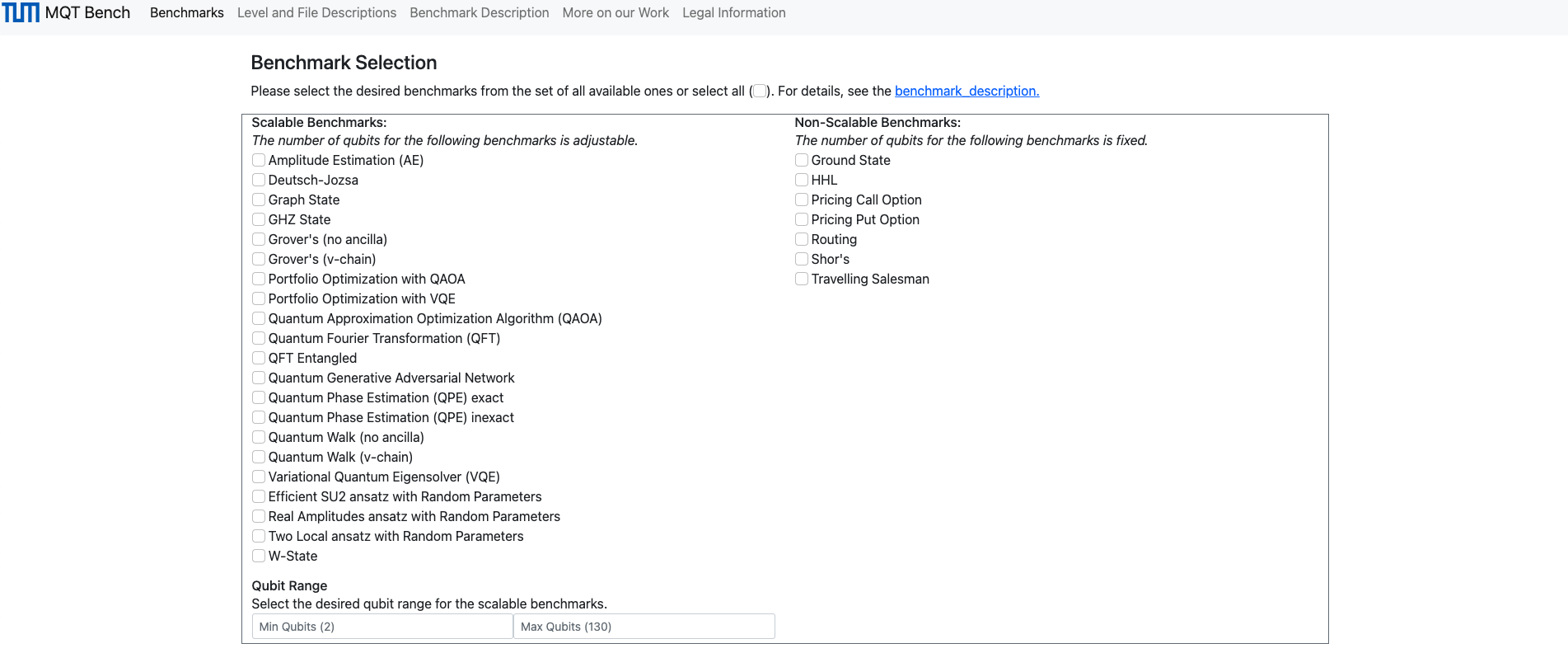
MQT Bench comes as an easy-to-use website with its user interface being shown below and a Python Package while all its implementations are open-source available on GitHub .
For more details, please refer to the following paper:
- N. Quetschlich, L. Burgholzer, and R. Wille. MQT Bench: Benchmarking Software and Design Automation Tools for Quantum Computing. Quantum, 2023. PDF
Contact
In case you have any problems with or questions, feel free to contact us via quantum.cda@xcit.tum.de .